
Miso One: Guide to the Open-Weights Voice Model for Expressive TTS
Voice AI is moving from flat narration toward more natural speech systems that can carry timing, emotion, pacing, and conversational context. That shift matters for creators, educators, product teams, and developers building voice agents. A transcript is useful, but a transcript that can become a clear, expressive voice track opens a different workflow: record, transcribe, edit, generate, caption, and publish from one content pipeline.
That is why search interest around Miso One has grown quickly. Miso One is the product-facing name people are using to evaluate Miso Labs' Miso TTS 8B release: an 8-billion-parameter, open-weights English text-to-speech model focused on expressive conversational speech, prompt-audio continuation, and local model evaluation.
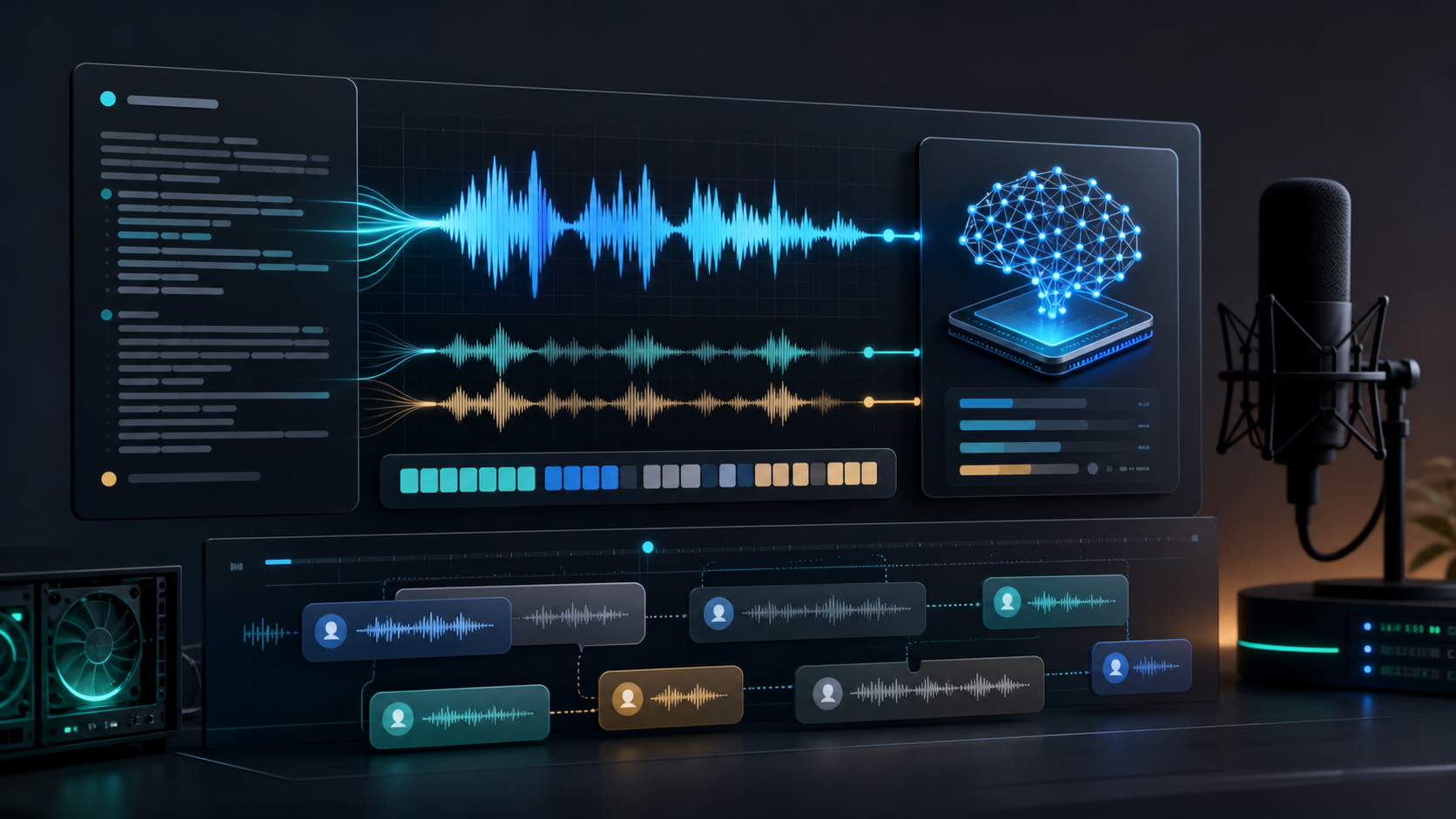
This guide explains what Miso One is, what makes Miso TTS 8B interesting, where it fits in a modern speech workflow, and how teams can evaluate it responsibly before treating it as production infrastructure.
What is Miso One?
Miso One is best understood as an accessible way to talk about the Miso TTS 8B model release from Miso Labs. The official Miso Labs announcement describes MisoTTS as an 8B-parameter model for emotive speech and dialogue generation. The public Hugging Face model card and MisoTTS GitHub repository provide the model facts, inference code, setup notes, and safety guidance.
At a high level, Miso TTS 8B is a text-to-speech model that can generate audio from text and optional audio context. That optional audio context is important. Traditional TTS systems often read text in a selected voice with limited control over delivery. Miso TTS 8B is designed around conversational speech generation, where prior audio can help guide style, rhythm, and voice continuation.
The current public model should not be described as a broad multilingual voice platform. The GitHub repository states that Miso TTS 8B currently supports English only. For SEO content, product pages, and internal planning, that distinction matters: Miso One is relevant for English expressive TTS research and workflows today, not every multilingual dubbing use case.
Why expressive TTS matters
Good text-to-speech is not only about pronunciation. Human speech carries meaning through pauses, stress, speed, breath, and emotional register. A sentence can sound confident, hesitant, instructional, relaxed, excited, or concerned without changing a single word.
That is the problem Miso One is trying to address. The model category is useful when a team needs audio that sounds less like a utility voice and more like a natural speaker. Common examples include:
- Product demo narration that needs energy without sounding like an ad read.
- Training content where the voice should be calm, clear, and patient.
- Podcast drafts where creators want to preview pacing before recording.
- Voice-agent research where response timing and tone are part of the experience.
- Accessibility workflows where written material becomes easier to consume as speech.
For WhisperWeb users, this is a natural extension of transcript work. Speech-to-text turns spoken media into editable language. Expressive TTS can turn that edited language back into audio for drafts, voiceovers, accessibility versions, and localization planning.
The model facts to know
The public Miso TTS 8B sources describe a large open-weights TTS model with a transformer-based architecture. The Hugging Face model card lists an 8B-parameter model, a Sesame-style conversational speech model direction, a large Llama-style backbone, a smaller autoregressive audio decoder, Mimi audio tokenization, 32 audio codebooks, and a maximum sequence length of 2,048.
The Miso Labs technical post explains the motivation in more detail. Speech is highly variable, and a simple flat audio-token vocabulary becomes impractical if you want to capture a large range of pitch, rhythm, emphasis, emotion, and accent. Miso TTS uses residual vector quantization so each audio frame can be represented across multiple codebooks instead of one flat token space.
For most product teams, the practical takeaway is simpler:
- It is large enough to require real serving planning.
- It is open enough to inspect and run locally.
- It focuses on expressive English conversational speech.
- It can use audio context for prompted generation.
- It ships with safety notes and watermarking expectations that teams should not ignore.
Those traits make Miso One especially interesting for teams comparing hosted voice APIs with self-hosted or research-friendly speech models.
Open weights change the evaluation process
Closed TTS APIs are convenient. You send text, choose a voice, receive audio, and pay for usage. That is still the right choice for many production products. Open weights solve a different problem: they let developers inspect the model path, run local experiments, benchmark their own hardware, and control more of the data lifecycle.
With Miso TTS 8B, the open-weights angle is a major part of the story. Developers can review the repository, download the public model files from Hugging Face, and run inference in their own environment. The GitHub quickstart uses Python tooling and points to CUDA/GPU deployment expectations rather than a lightweight browser-only runtime.
That matters for privacy-sensitive audio workflows. If a team is building around interviews, internal calls, training material, or proprietary scripts, local evaluation can reduce the amount of media sent to third-party services. It also gives engineering teams a clearer path to benchmark latency, memory use, prompt length behavior, and output consistency under their own constraints.
Open weights do not remove product work. They shift it. Teams still need serving infrastructure, monitoring, consent policies, abuse prevention, watermarking, and quality review before generated speech reaches users.
Miso One and voice continuation
One of the strongest reasons people search for Miso One is voice continuation. The public repository documents prompted generation, where the model can condition on prior audio and transcript context before generating the next sentence.
That capability can be useful, but it needs careful boundaries. Voice continuation should be tested only with audio the user has the right to use. It should not be positioned as a tool for impersonation, deceptive audio, fraud, or consent-free cloning. The MisoTTS repository includes safety guidance against impersonation and harmful use, and it notes generated audio is watermarked by default.
In practical creator workflows, the responsible version looks like this:
- Use consented source audio or a voice the creator owns.
- Transcribe the source with a tool such as WhisperWeb.
- Edit the script for clarity and timing.
- Generate short voice sections for review.
- Compare the output against style, pronunciation, and disclosure requirements.
- Keep watermarking and consent rules in the publishing workflow.
This keeps Miso One in the category where it is most useful: a research and production-assistive voice model, not an excuse to blur identity and permission.
How Miso One fits with WhisperWeb
WhisperWeb is built around browser-first speech workflows: capture audio, transcribe it, review the result, summarize, translate, and export useful text assets. Miso One sits on the other side of that loop. It can take edited text and help teams evaluate generated speech.
A practical workflow could look like this:
- Record or upload an interview, lesson, product demo, or narration draft in WhisperWeb.
- Generate a transcript and clean up the script.
- Use WhisperWeb's summary and editing flow to create shorter narration sections.
- Send approved English text to a Miso TTS 8B test environment.
- Review audio for emotion, pacing, and pronunciation.
- Export captions and transcript notes alongside the generated audio for publishing.
This transcript-to-voice loop is valuable because it keeps the human editor in control. The AI model does not decide the message. It helps transform approved copy into an audio draft that can be tested, revised, and published with the right review process.
What to benchmark before production
Miso Labs and Miso One pages discuss low-latency voice use cases, but real latency always depends on deployment. Hardware, batch size, precision, prompt length, server load, and network routing all affect the final experience.
Before production, teams should run their own evaluation set:
- Latency: Measure first-audio time and total generation time for realistic scripts.
- Quality: Test emotional range, long sentences, pauses, numerals, names, and domain terms.
- Stability: Listen for drift across longer passages and repeated generations.
- Prompt audio: Test consented reference audio under noisy, short, and clean conditions.
- Hardware fit: Measure VRAM, throughput, and cost on the target GPU.
- Safety: Confirm watermarking, disclosure, and abuse-prevention requirements.
- Workflow fit: Decide whether self-hosting beats a hosted API for your actual users.
The goal is not to prove that one model wins every use case. The goal is to learn where Miso One is strong enough to become part of your stack.
Miso One vs traditional TTS tools
Traditional TTS tools are often optimized for reliability, voice catalogs, and predictable output. That is useful for help centers, voiceovers, IVR systems, and basic accessibility.
Miso One is more interesting when the problem is expressiveness and control. It gives developers and researchers a way to test a newer open-weights model with local inference potential and prompt-audio behavior. That makes it a better fit for evaluation-heavy teams than for people who only need a simple "paste text, download MP3" workflow.
For many teams, the best answer will be hybrid:
- Use WhisperWeb for transcription, cleanup, subtitles, and content structure.
- Use Miso One or Miso TTS 8B for expressive English voice experiments.
- Use hosted TTS APIs when reliability, support, and scale matter more than local control.
- Keep human review in the loop for anything published externally.
Limitations to keep in mind
Miso One is new, and new voice models should be tested carefully. The public Miso Labs post notes that the current system models individual turns and half-duplex audio, while full turn-taking and full-duplex conversation remain future work. The GitHub repository also states English-only support today and recommends appropriate GPU resources for local use.
Those limitations do not make the model less interesting. They make the evaluation more realistic. If you are building a voice agent, latency and turn-taking matter. If you are creating long-form narration, stability and editorial review matter. If you are experimenting with voice continuation, consent and watermarking matter.
Final take
Miso One is worth watching because it brings a serious open-weights model into a part of voice AI that has often been dominated by closed APIs: expressive, conversational text-to-speech. The public Miso TTS 8B release gives developers a way to inspect, run, and benchmark a large English voice model on their own terms.
For creators and teams already using WhisperWeb, the opportunity is practical. Transcription turns audio into editable text. Miso One-style TTS can turn approved text back into expressive speech. Used responsibly, that loop can speed up voiceover drafts, accessibility audio, training narration, and voice-agent research while keeping humans in charge of what gets published.